


Gram Panchayat Layouts Telangana: Rules, Permissions & Approvals.
Imagine your perfect home in a peaceful Gram Panchayat area. But before you start building, there’s something important you need: “Housing Permission”. It’s like a special stamp of approval from the village authorities to make sure your home is built correctly.
Building approval comes from a special organization set up by the government. These rules they have aren’t just about the building, they’re also about making sure everything works smoothly inside and traffic flows well around it.
If you don’t follow these rules, things can get really serious. You might even end up losing the building you constructed. So, it’s super important to get the right permissions and stick to the rules.
Are you ready to learn how to make your dream home a reality by following the right steps?
Let’s explore the world of housing permissions online together!
Gram Panchayat Official Website
The Telangana State Government has a dedicated website to Gram Panchayat.
https://epanchayat.telangana.gov.in
By visiting the website, individuals can navigate through the various sections to understand the process of getting permissions for the layouts, buildings under Gram Panchayat.
To make it easier to understand, we’ll break down buildings/housing permission into simple steps.
Let’s begin!
Before going into the official process, Do you know what documents are required for building permission?
Documents Required For Building Permission
Here are the documents one should have before applying for building permission in Telangana
- Building Application in Annexure-G (as per G.O.Ms.No.67, PR&RD, Dated 26.02.2002) duly signed by the Owner, Builder, Architect, Structural Engineer
- Ownership Document of Site/Plot
- Extract of Master Plan / ZDP
- Building Plans duly signed by Owner, Builder, Architect/Engineer/Surveyor, Structural Engineer (Scanned Copy of Plan)
- Location Plan (Topographical Plan) (scale 1:2000)
- Contour Plan (in case of undulating terrain)
- Site Plan (Drawn to scale 1:500)
- The plans of the building elevations and sections drawn to a scale of not less than 1:100 of all floors showing uses of all parts of the building;
- Plan showing rainwater harvesting pits (scale 1:100)
- Previous Sanctioned Plan Copy (if the existing building on the site was sanctioned previously)
- Up-to-date Property Tax Receipt if Old Structure renovation
- N.O.C. from Airport Authority of India, if applicable.
- N.O.C. & approved plans from Telangana State Disasters Response & Fire Services Department, if applicable
- ORC issued by the RDO in case of Inam lands wherever necessary
- NOC issued by the Collector for alienation of land in respect of assignment to freedom fighters / Defense persons. Wherever necessary
- N.O.C from MRO / Collector if the land under reference is recorded as Government land as per records. Wherever necessary.
- N.O.C from defense/military authorities.
Here’s how you can navigate the steps for applying for permission using these documents on a website.
Applying Building Permission
Visit the official Telangana epanchayat website. (link provided in above section)
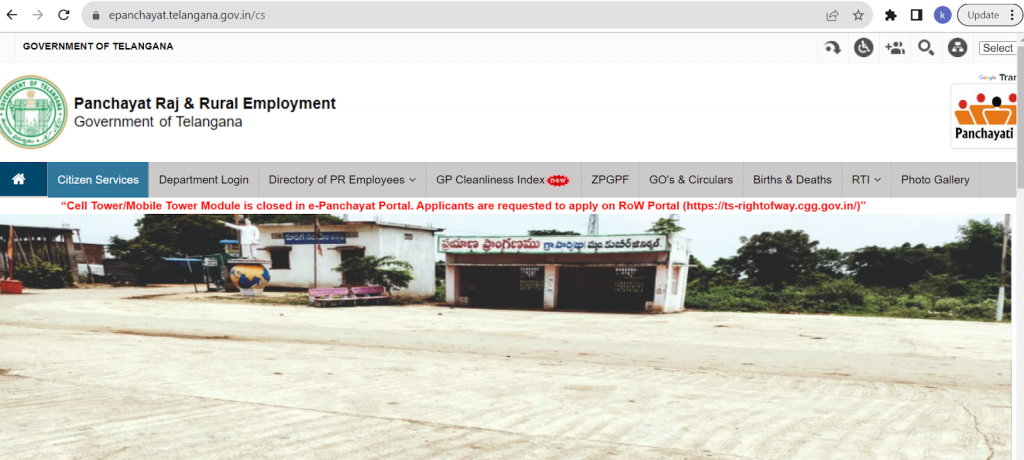
On the Home page, Click on the “Citizen Services” option in the menu bar.
You will be redirected to the login page of it.
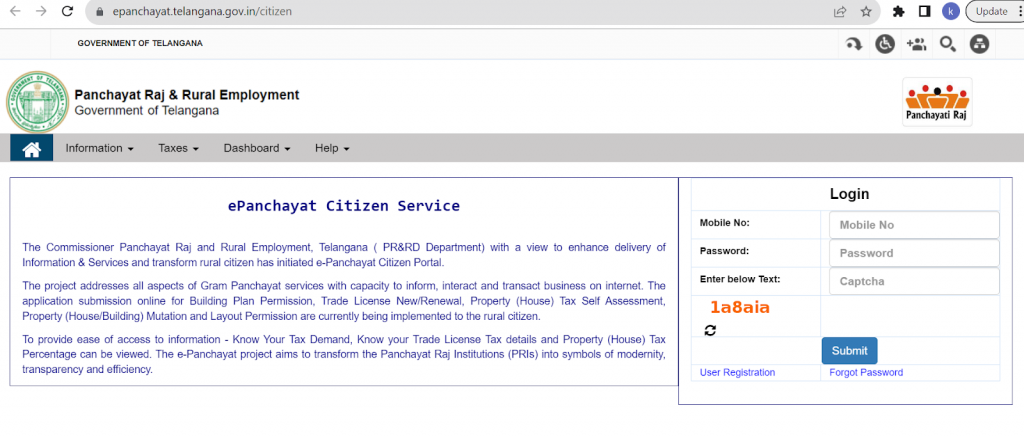
Here, if you already have an account, then continue login by entering required field details.
If not, click on the “User Registration” link below the submit button and create a new user.

Ok, once you have registered and logged into your account.
Click on “Building Permission” in the menu bar and select the “Apply” option from the dropdown menu.

There you go,
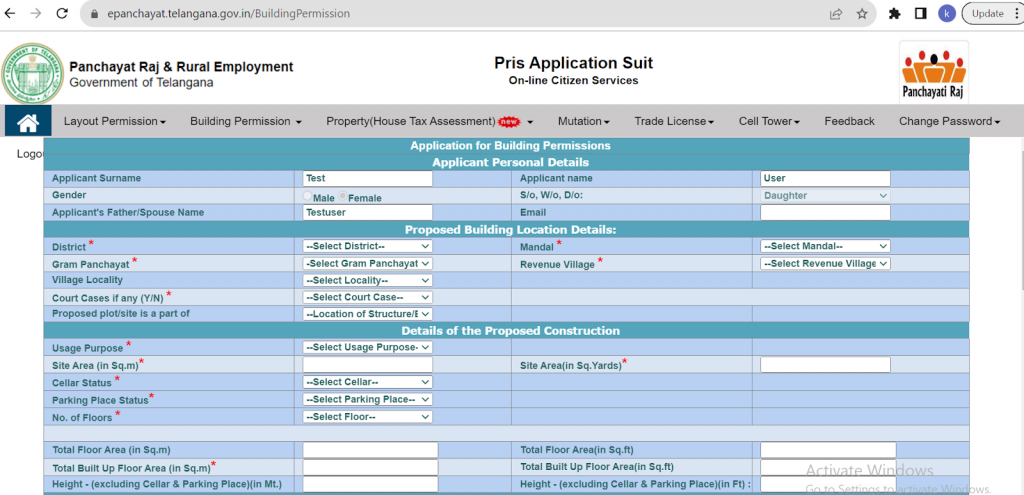

Enter the mandatory field details and don’t forget to upload the necessary documents.
Finally, complete the application process by clicking on the “Save and Forward” option below.
In case the application receives feedback with remarks, the applicant using the website can make necessary modifications or corrections to address the issues and then resubmit the application.
You can modify the application by clicking on the “Modify” option in the dropdown menu.
Correct the details and resubmit the form.
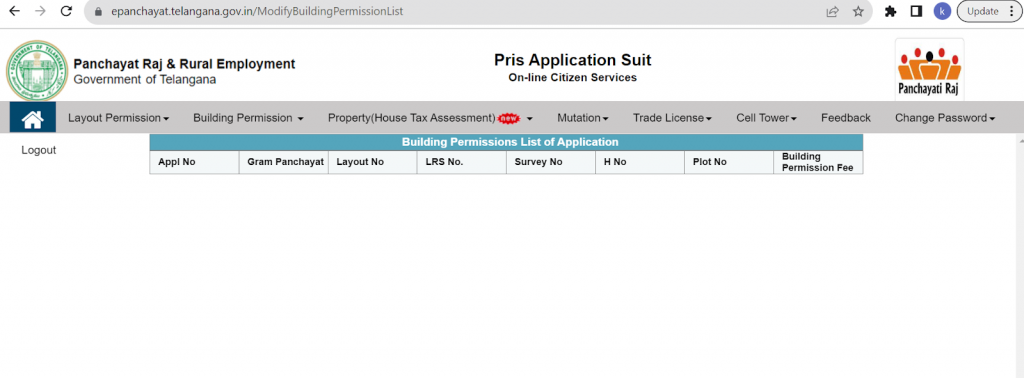
Now, the application for building permission will undergo a verification process. If the Gram Panchayat finds that all the conditions are met, they will grant approval to the application.
You can verify status and application number by selecting “Verify Status” option from dropdown
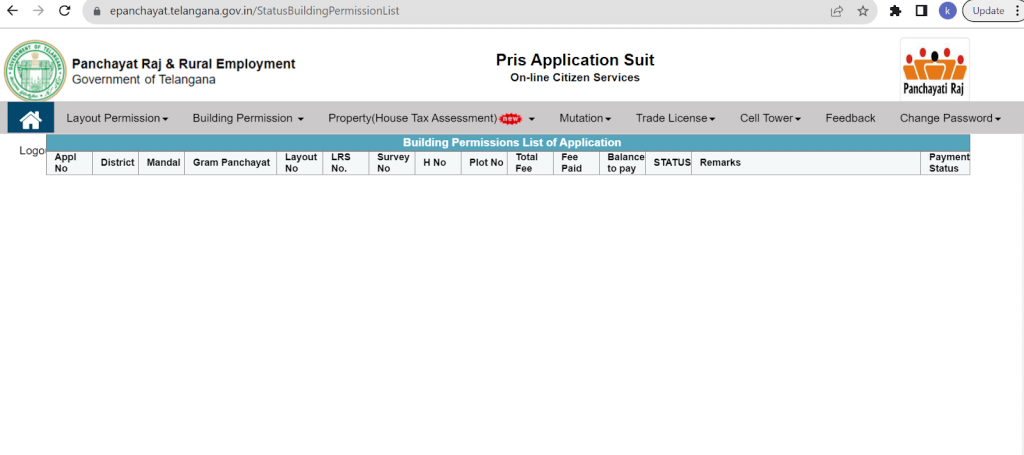
For the payment process, go to “Make Payment” and payment details for your application.
You can proceed to pay the building permission fee at MeeSeva Centres.

After making the required fee payment, the Gram Panchayat will upload the certificate confirming the approval of the building permission plan.
Once everything is completed from both applicant and authorities, Gram Panchayat will issue a certificate for the building permission.
Select “Download Certificate” from the dropdown to download your certificate.
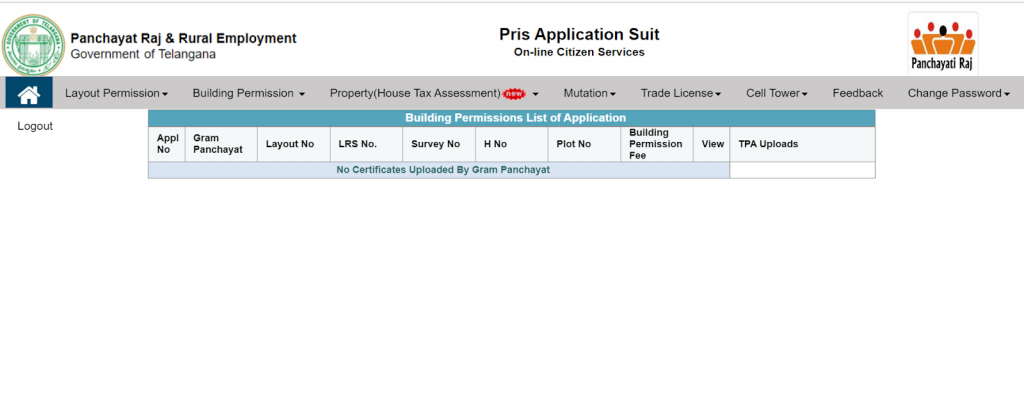
Note: Buildings permissions above G+2 Applications will be forwarded to DTCP or UDA for approval.
Fee Structure For Building Permission
| Prices (As per rule 27) | |||
| S. No. | Details of the Item | Gram Panchayats falling In UDA, Peripheral Gram Panchayats of Municipalities, Major Gram Panchayats, And declared potential areas | Minor GramPanchayat |
| 1. | Building Permit Fee | ||
| a) Residential | |||
| i) Semi Permanent/Thatched | Rs.50.00 per Structure | ||
| ii) Permanent | Rs.10.00 per.M2 of built up Area subject to minimum of Rs.200.00 | Rs.2.00 per M2 of built up area subject to minimum of Rs.100.00 | |
| b) Non-Residential | Rs.20.00 per.M2 of built up Area subject to minimum of Rs.1000.00 | Rs.4.00 per M2 of built up area subject to minimum of Rs.200.00 | |
| 2. | Renewal of lay out /building plan | 20% of the total fees | 10% of the total fee |
| 3. | Penalty for | ||
| a) violation of rules | Rs.1,000.00 | Rs.500.00 | |
| b) for continuing offense | Rs.10.00 per day | Rs.5.00 per day | |
| 4. | Other fee | ||
| a)Building Application, Annexure Form and others annexures | Rs.10.00 each | Rs.5.00 each | |
| b) Unobjectionable encroachment | Rs.1.00 per M2 | Rs.0.50 per M2 | |
Rules For Building Permission In Gram Panchayat
- When you apply for permission to build a structure, you need to include a site plan in the application. This plan must be drawn to a certain size (1:500) and should show:
- The road or way to reach the site and how wide it is.
- The site’s boundaries and measurements, along with any nearby land you own.
- How the site is positioned in relation to nearby streets, if there are any.
- Make sure there’s enough space around the building for air, light, and cleaning.
- If there are any existing things like wells, drains, or trees, mark them.
- Measure the whole area of the property and how much of it will be used for the building.
- Draw plans that show the building’s sides and inside parts. This should be at least 1:100 in size for all floors and show how each part will be used.
- Give details about what the building will be like and what materials will be used. Also, tell about things like water supply and drainage. These details should be signed by the owner and a qualified surveyor, engineer, or architect, as mentioned in the application form in Annexure G.
- You don’t need special permission for small changes or fixes in existing buildings. These changes include things like adding or closing a window or door, building a fence or wall, putting in doors between rooms, painting, fixing walls, and redoing the floor.
- For buildings like offices, factories, and those with more than two floors (excluding shops), the smallest plot size needed is 300 square meters.
- For apartment buildings and complexes where people live, the smallest plot size needed is 335 square meters.
- The smallest road needed to reach a place in a Gram Khantam or Settlement area should be at least 3.6 meters wide.
- If the place is outside a settlement area, then the road needed to reach it should be at least 10 meters wide.
- For places with groups of houses or any kind of buildings, like homes or shops, the road needed to reach them should be at least 12 meters wide.
- Building Permission minor gram panchayats:
| Area Type | Height Permissible | Setbacks (in meters) |
| Gram Khantam | 9 meters or G+2 floors | Front:1.50 Rear:1.00 |
| Revenue Survey Numbers | 13 meters or G+3 floors | Front:3.00 Rear:2.00 Sides:1.50 each |
- Building Permission major gram panchayats:
| Area Type | Height Permissible | Setbacks (in meters) |
| Gram Khantam | 9 meters or G+2 floors | Front:1.50 Rear:2.00 |
| Residential | 13 meters or G+3 floors | As per the plot size table below |
| Non-Residential | 15 meters or G+4 floors | As per the plot size table below |
| Individual needs | As per specific requirement | As per the plot size table below |
Plot Size for Setbacks:
| Plot Size( in sq. meters) | Road Size | Rear | Sides |
| Up to 50 | 0.75 | – | – |
| 51-100 | 1.00 | 1.00 | 0.50 |
| 101-150 | 1.50 | 1.50 | 1.00 |
| 151-300 | 1.50 | 2.00 | 2.00 |
| 301-500 | 3.00 | 2.00 | 2.00 |
| Above 500 | 3.00 | 3.00 | 3.00 |
- For both major and minor gram panchayats, buildings with inner courtyards, a sky-open space of at least 3.0 sq. meters (no side less than 1.5 meters) is required.
- Restrictions:
- No construction is allowed in water bodies like rivers, lakes, ponds, or nalas.
- For large rivers and lakes (surface area 10 Ha and above), keep a distance of 30 meters from their boundaries.
- For small lakes (surface area less than 10 Ha), maintain a 15-meter distance from their boundaries.
- Stay at least 9 meters away from nalas, canals, and similar water bodies.
- If you want to build near airports, Defence areas, or Military establishments, you need permission from the respective authorities.
- Keep a safety gap of 3 meters between buildings and high tension electricity lines.
- Maintain a minimum of 30 meters distance from railway property. In built-up areas with high land cost, ensure enough space for railway interests.
Note: The rules do not apply to certain government construction projects that are needed for important services like Railways, Big roads like National Highways and State Highways, Projects managed by local government bodies like District Administration, Zilla Praja Parishad, and Gram Panchayat, Waterways, Ports, Airports, Defense projects, Any other service that the government says is important for the public.
